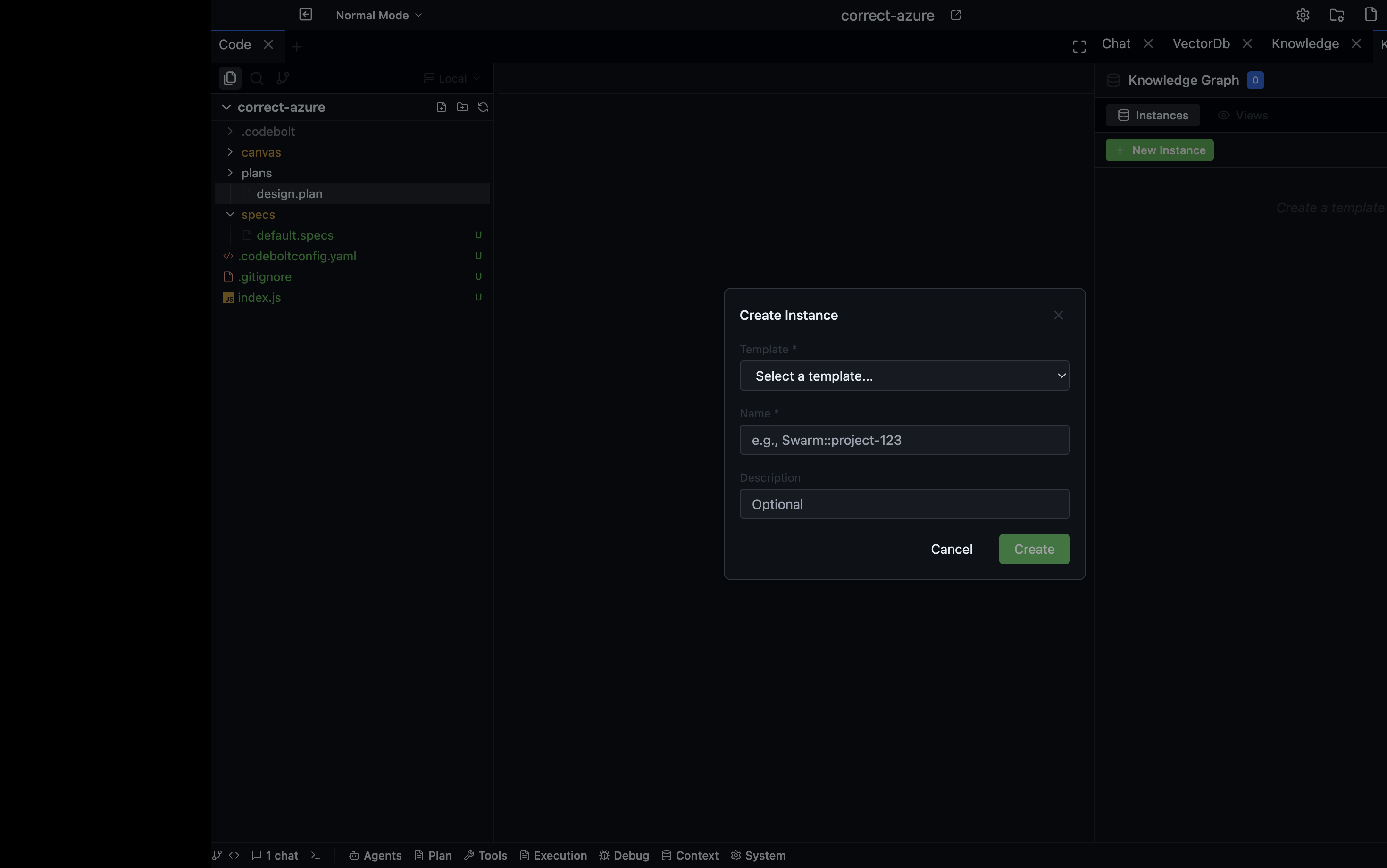
Knowledge Graph
The Knowledge Graph is a graph database layer for storing typed entities (nodes), relationships (edges), and Cypher-like queryable views. It is built on Kuzu DB, an embedded graph database, and follows a schema-first approach: define templates, create instances, then populate data.
Storage Layout
All data lives under the project directory:
| Path | Purpose |
|---|---|
{projectPath}/.codebolt/knowledgegraph/kuzu/ | Kuzu embedded database files |
{projectPath}/.codebolt/knowledgegraph/instance-templates/{id}.json | Instance template definitions |
{projectPath}/.codebolt/knowledgegraph/instances/{id}.json | Instance metadata |
{projectPath}/.codebolt/knowledgegraph/view-templates/{id}.json | View template definitions |
{projectPath}/.codebolt/knowledgegraph/views/{id}.json | View bindings |
Kuzu Tables
Node table
| Column | Type | Description |
|---|---|---|
id | STRING | Unique node identifier |
name | STRING | Human-readable name |
kind | STRING | Record kind (maps to template definition) |
memory_instance_id | STRING | Owning instance |
attributes | STRING | JSON-encoded attribute map |
valid_from | STRING | Validity start timestamp |
valid_to | STRING | Validity end timestamp |
created_at | STRING | Creation timestamp |
Edge table
| Column | Type | Description |
|---|---|---|
id | STRING | Unique edge identifier |
kind | STRING | Relationship type |
memory_instance_id | STRING | Owning instance |
created_at | STRING | Creation timestamp |
The current schema version is 2. All timestamp columns use STRING rather than native Kuzu timestamp types to avoid a known crash in the Kuzu engine.
Core Concepts
Instance Template
An instance template is the schema definition for a graph. It declares what node types and edge types are allowed.
record_kinds-- A map of node type names to their field definitions.edge_types-- A map of relationship names withfrom/toconstraints that referencerecord_kinds.
Each field in a record kind has:
| Property | Description |
|---|---|
type | A Kuzu field type (see below) |
required | Whether the field must be present |
description | Human-readable explanation |
itemType | Element type when type is LIST |
Supported Kuzu field types: STRING, INT64, INT32, INT16, INT8, UINT64, UINT32, UINT16, UINT8, DOUBLE, FLOAT, BOOL, DATE, TIMESTAMP, INTERVAL, UUID, LIST, MAP, STRUCT, BLOB.
Instance
An instance is a live graph created from a template.
- Linked to a template by
templateId. - Tracks
nodeCountandedgeCount(refreshed from Kuzu on read). - Instance ID is derived from a sanitized version of its name.
Memory Record (Node)
A memory record represents a single node in the graph.
| Field | Description |
|---|---|
id | Unique identifier |
name | Display name |
kind | Must match a record_kinds entry in the template |
attributes | Record<string, any> -- stored as JSON in Kuzu |
valid_from | Optional validity start |
valid_to | Optional validity end |
Attributes are validated against the template schema on every insert and update.
Edge
An edge represents a directed relationship between two nodes.
| Field | Description |
|---|---|
id | Unique identifier |
kind | Must match an edge_types entry in the template |
from_node_id | Source node |
to_node_id | Target node |
The from and to nodes must match the record kinds declared in the template edge type definition.
View Template
A view template is a reusable query definition written in a Cypher-like DSL.
| Clause | Required | Description |
|---|---|---|
match | Yes | Starting node pattern |
patterns | No | Edge traversal patterns |
where | No | Filter conditions |
with | No | Computed expressions with aliases |
orderBy | No | Sort specification |
skip | No | Offset |
limit | No | Maximum results |
return | Yes | Field selection with aliases |
applicable_template_idsrestricts which instance templates a view template can query.
View
A view is an active binding of a view template to a specific instance. Executing a view runs the translated Cypher query against that instance's data.
Query Translation
The translateViewToCypher() function converts the DSL into executable Cypher:
- MATCH clause --
MATCH (alias:Node {kind: 'recordKind', memory_instance_id: instanceId}) - Pattern clauses -- Edge traversals respecting direction (
outgoing,incoming,both). - WHERE clause -- Condition translation with supported operators:
- Comparison:
=,!=,<>,>,<,>=,<= - String:
CONTAINS,STARTS WITH,ENDS WITH - Collection:
IN,NOT IN - Null checks:
IS NULL,IS NOT NULL
- Comparison:
- WITH clause -- Computed expressions with aliases.
- ORDER BY, SKIP, LIMIT -- Standard pagination and sorting.
- RETURN clause -- Field selection with optional aliases.
Schema Validation
Three validation functions enforce data integrity:
validateRecordAgainstSchema()-- Checks node attributes against the template's record kind fields. Validates required fields and Kuzu type compatibility.validateEdgeAgainstSchema()-- Confirms thatfromandtonodes match the template's edge type definitions.validateKuzuFieldType()-- Performs type validation for all supported Kuzu field types.
Subgraph and Graph Visualization
Two endpoints support interactive graph exploration:
getSubgraph(instanceId, limit, seedNodeId)
Retrieves a bounded subgraph starting from an optional seed node. Returns:
nodes-- Each node includesinDegreeandoutDegreecounts.edges-- Relationships within the subgraph.totalCounts-- Total nodes and edges in the instance.hasMore-- Whether additional data exists beyond the limit.
expandNode(instanceId, nodeId, direction, limit, excludeNodeIds)
Expands a single node's neighborhood in a given direction. Returns the same structure as getSubgraph.
Corruption Recovery
Kuzu DB corruption is handled automatically:
isCorruptionError()inspects errors for known Kuzu corruption indicators.deleteCorruptedDatabase()removes the entire Kuzu directory.initializeDatabase()detects corruption on startup, deletes the corrupt database, and recreates it from scratch.
WebSocket Events
The Knowledge Graph emits 20 event types for real-time UI updates:
| Category | Events |
|---|---|
| Instance template | created, updated, deleted |
| Instance | created, updated, deleted |
| Memory record | added, records-added, updated, deleted |
| Edge | added, edges-added, deleted |
| View template | created, updated, deleted |
| View | created, deleted |
REST API
Instance Templates
| Method | Endpoint | Description |
|---|---|---|
POST | /kg/instance-templates | Create a template |
GET | /kg/instance-templates | List all templates |
PUT | /kg/instance-templates | Update a template |
DELETE | /kg/instance-templates | Delete a template |
Instances
| Method | Endpoint | Description |
|---|---|---|
POST | /kg/instances | Create an instance |
GET | /kg/instances | List all instances |
DELETE | /kg/instances | Delete an instance |
Records (Nodes)
| Method | Endpoint | Description |
|---|---|---|
POST | /kg/instances/:id/records | Add a record |
GET | /kg/instances/:id/records | List records |
GET | /kg/instances/:id/records/:recordId | Get a single record |
PUT | /kg/instances/:id/records/:recordId | Update a record |
DELETE | /kg/instances/:id/records/:recordId | Delete a record |
Edges
| Method | Endpoint | Description |
|---|---|---|
POST | /kg/instances/:id/edges | Add an edge |
GET | /kg/instances/:id/edges | List edges |
DELETE | /kg/instances/:id/edges/:edgeId | Delete an edge |
View Templates
| Method | Endpoint | Description |
|---|---|---|
POST | /kg/view-templates | Create a view template |
GET | /kg/view-templates | List view templates |
PUT | /kg/view-templates | Update a view template |
DELETE | /kg/view-templates | Delete a view template |
Views
| Method | Endpoint | Description |
|---|---|---|
POST | /kg/views | Create a view |
GET | /kg/views | List views |
DELETE | /kg/views | Delete a view |
GET | /kg/views/:id/execute | Execute a view query |
Graph Exploration
| Method | Endpoint | Description |
|---|---|---|
GET | /kg/instances/:id/subgraph | Retrieve a bounded subgraph |
POST | /kg/instances/:id/expand-node | Expand a node's neighborhood |
SDK Reference
Create an Instance
import codebolt from '@codebolt/codeboltjs';

// Create the template first
const template = await codebolt.knowledgeGraph.createInstanceTemplate({
  name: 'codebase-map',
  record_kinds: {
    Module: {
      fields: {
        path: { type: 'STRING', required: true, description: 'File path' },
        language: { type: 'STRING', required: false, description: 'Programming language' }
      }
    },
    Function: {
      fields: {
        name: { type: 'STRING', required: true, description: 'Function name' },
        lineNumber: { type: 'INT64', required: false, description: 'Start line' }
      }
    }
  },
  edge_types: {
    CONTAINS: { from: 'Module', to: 'Function' },
    CALLS: { from: 'Function', to: 'Function' }
  }
});

// Create an instance from the template
const instance = await codebolt.knowledgeGraph.createInstance({
  name: 'my-project-map',
  templateId: template.id
});
Add Records and Edges
// Add nodes
const moduleNode = await codebolt.knowledgeGraph.addMemoryRecord(instance.id, {
  name: 'auth-module',
  kind: 'Module',
  attributes: { path: 'src/auth/index.ts', language: 'typescript' }
});

const funcNode = await codebolt.knowledgeGraph.addMemoryRecord(instance.id, {
  name: 'validateToken',
  kind: 'Function',
  attributes: { name: 'validateToken', lineNumber: 42 }
});

// Add an edge
await codebolt.knowledgeGraph.addEdge(instance.id, {
  kind: 'CONTAINS',
  from_node_id: moduleNode.id,
  to_node_id: funcNode.id
});
Create and Execute a View
// Define a reusable query
const viewTemplate = await codebolt.knowledgeGraph.createViewTemplate({
  name: 'all-functions-in-module',
  applicable_template_ids: [template.id],
  match: { alias: 'm', recordKind: 'Module' },
  patterns: [
    { from: 'm', edge: 'CONTAINS', to: { alias: 'f', recordKind: 'Function' }, direction: 'outgoing' }
  ],
  return: [
    { expression: 'm.name', alias: 'module' },
    { expression: 'f.name', alias: 'function' }
  ]
});

// Bind it to an instance
const view = await codebolt.knowledgeGraph.createView({
  viewTemplateId: viewTemplate.id,
  instanceId: instance.id
});

// Execute the query
const results = await codebolt.knowledgeGraph.executeView(view.id);
Delete a Record
await codebolt.knowledgeGraph.deleteMemoryRecord(instance.id, recordId);