Context Assembly
Context Assembly orchestrates the read path for memory in Codebolt. It evaluates rules, executes multiple persistent memory pipelines in parallel, merges the results, enforces token budgets, and returns assembled context ready for the LLM.
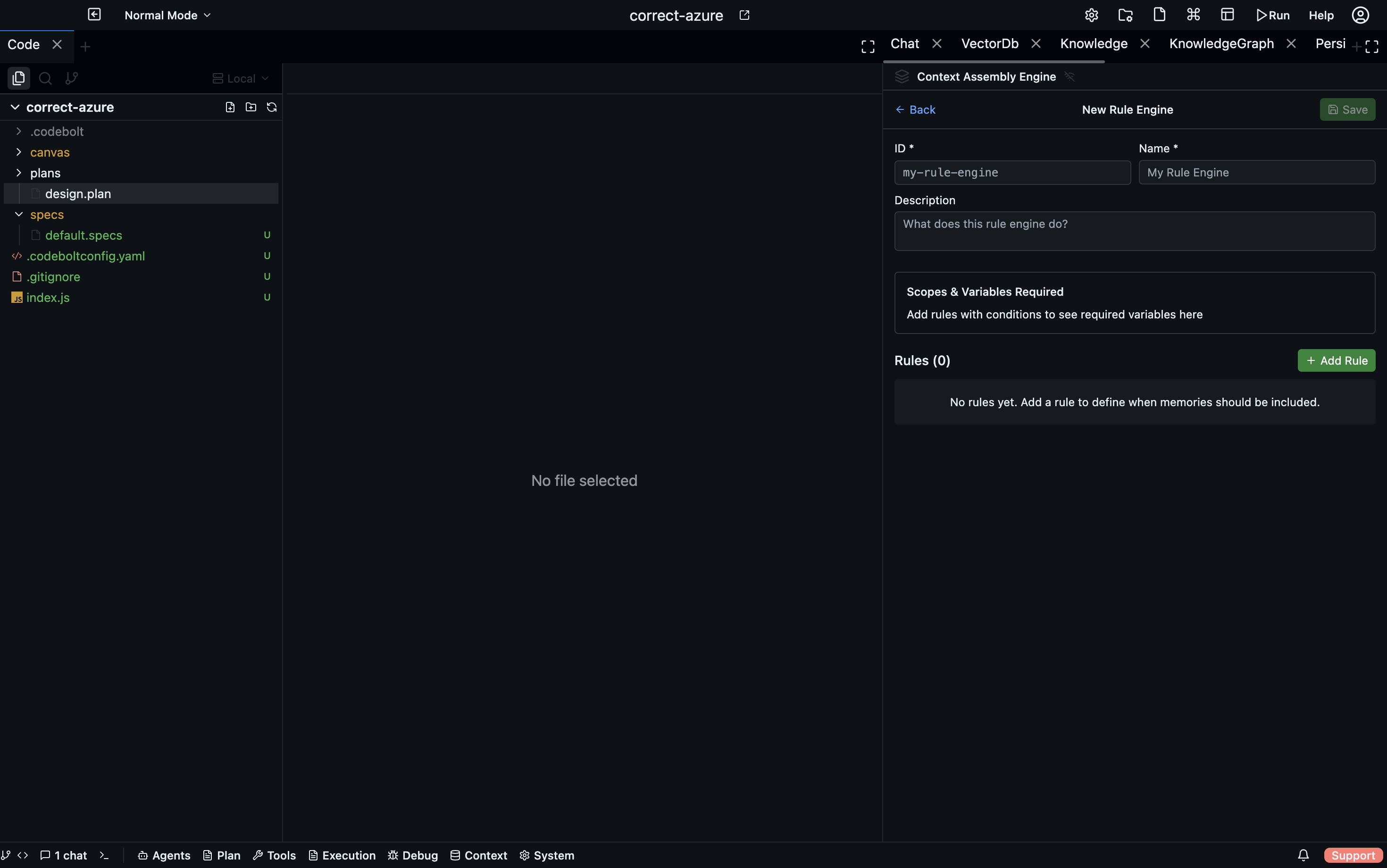
The system comprises two sub-systems:
- Context Rule Engine — determines which memories to activate based on the current scope and conditions.
- Context Assembly Service — executes the resolved memory pipelines and merges their output.
Storage
| Component | Location |
|---|---|
| Rule engine definitions | {projectPath}/.codebolt/context-rule-engines/{id}.json |
| Assembly service | No dedicated storage — reads from Persistent Memory definitions and storage layers at runtime |
Context Assembly Request
Every assembly call begins with a request object:
{
  scope_variables: ScopeVariables,          // REQUIRED — all scope vars
  additional_variables?: AdditionalVariables, // phase, query, custom
  input?: { text?: string },                // semantic search text
  explicit_memory?: string[],               // specific memory type IDs to include
  constraints?: { max_tokens?: number },
  rule_engine_ids?: string[]                // which rule engines to evaluate
}
Scope Variables (8 Scopes, Hierarchical)
Scope variables describe the current execution context. Eight scopes are supported:
| Scope | Fields |
|---|---|
| SwarmScopeVars | swarm_id, swarm_name |
| ProjectScopeVars | project_id, project_path |
| AgentScopeVars | agent_id, agent_name, agent_type |
| ThreadScopeVars | thread_id |
| TaskScopeVars | task_id, task_type |
| UserScopeVars | user_id |
| OrgScopeVars | org_id |
| OrchestratorScopeVars | orchestrator_id |
The internal helper flattenVariables() merges all scope and additional variables into a flat Record<string, any> for use by the rule engine and pipeline execution.
Assembly Execution Flow
The assembly process runs through seven sequential stages:
1. validateRequest(request)
   ├─ Check scope_variables present
   ├─ Verify explicit memories exist
   ├─ Validate constraints
   └─ Check rule engines exist

2. resolveMemories(request)
   ├─ Start with explicit_memory list
   ├─ Load enabled rule engines (or specific rule_engine_ids)
   ├─ evaluateRules() against flattened variables
   ├─ Merge: explicit memories + rule-matched memories (deduplicated)
   └─ Build trace: which memories from explicit vs rules

3. Execute pipelines IN PARALLEL
   ├─ For each resolved memory: load PersistentMemory definition
   ├─ Call persistentMemoryPipelineService.executePipeline(memoryId, intent, threadId)
   ├─ Collect ContextItem[] from each pipeline
   └─ Emit 'contextAssembly:pipelineComplete' per pipeline

4. mergeResults(allItems)
   ├─ Deduplicate by content hash (MD5 or string equality)
   └─ Return unique ContextItem[]

5. applyContributionRules(items)
   ├─ Group items by their memory's contribution.section
   ├─ Within each section: sort by priority weight
   ├─ Apply max_items limit per memory type
   └─ Return Record<string, ContextItem[]> keyed by section

6. enforceBudget(sections, constraints)
   ├─ If max_tokens set: estimate tokens per section
   ├─ Truncate lowest-priority sections first until under budget
   └─ Return { sections, truncated: boolean, tokenEstimate }

7. Return AssembledContext
   ├─ context: Record<string, ContextItem[]>
   ├─ trace: { memory_calls, rules_applied, variables_used, missing_variables }
   └─ meta: { token_estimate, total_items, truncated, duration_ms }
Context Sections and Ordering
Sections appear in this fixed order in assembled context:
| Order | Section |
|---|---|
| 1 | state |
| 2 | warnings |
| 3 | constraints |
| 4 | knowledge |
| 5 | history |
| 6 | suggestions |
| 7 | working_memory |
Within each section, items are sorted by priority weight:
| Priority | Weight |
|---|---|
critical | 4 |
high | 3 |
medium | 2 |
low | 1 |
Token Budget Enforcement
- Estimation:
estimateTokens()uses a simple heuristic ofstring length / 4. - Truncation: When a
max_tokensconstraint is set and the assembled context exceeds it, items are removed starting from the lowest-priority sections first. - Metadata: When truncation occurs, the response
metaobject setstruncated: true.
Context Rule Engine
The rule engine decides which persistent memories to activate for a given assembly request.
Rule Engine Definition
{
  id: string,
  name: string,
  description: string,
  enabled: boolean,
  rules: ContextRule[]
}
Rule Structure
{
  id: string,
  name: string,
  priority: number,              // higher = evaluated first
  when: ContextRuleCondition[],  // ALL must match (AND logic)
  then: { add_memories: string[] } // memory type IDs to include
}
Each rule has a set of when conditions that use AND logic — all conditions must match for the rule to fire. When a rule matches, its then.add_memories list is added to the set of memories to assemble.
Rule Evaluation
evaluateRules(request, ruleEngines) proceeds as follows:
- Build variable lookup: a flat map with prefixes
scope.,addVar.,input.. - For each engine (if enabled):
- Sort rules by priority (descending).
- For each rule: evaluate ALL conditions.
- If all conditions match: add the rule's memories to the matched set.
- Collect:
matchedMemories[],engineResults[],variablesUsed[].
Condition Operators
The rule engine supports 14 condition operators:
| Operator | Description |
|---|---|
exists | Field has a value (not null/undefined) |
not_exists | Field is null/undefined |
eq | Strict equality |
neq | Not equal |
in | Value is in array |
not_in | Value is not in array |
contains | String contains substring |
starts_with | String starts with prefix |
ends_with | String ends with suffix |
gt | Greater than (numeric) |
gte | Greater than or equal |
lt | Less than |
lte | Less than or equal |
regex | Regular expression match |
Variable Lookup Building
buildVariableLookup(request) creates a flat map from the request:
- From
scope_variables:scope.swarm.swarm_id,scope.agent.agent_name, etc. - From
additional_variables:addVar.phase,addVar.query,addVar.{custom} - From
input:input.text
Variable Extraction
Two helpers support UI integration and validation:
extractPossibleVariables(ruleEngines, memories)
- Scans all rule conditions for referenced variable fields.
- Scans all memory definitions for
inputs_scopeandadditional_variables. - Returns
PossibleVariable[]for populating UI dropdowns.
getRequiredVariables(memories)
- Extracts required scope variables from memory
inputs_scope. - Extracts required additional variables.
- Returns what the caller must provide in the request.
Rule Engine CRUD
| Operation | Behavior |
|---|---|
| Create | Generates IDs for rules without IDs, saves JSON to disk |
| Update | Merges updates, generates IDs for new rules |
| Delete | Removes the JSON file |
| AddRule | Adds a rule to an existing engine |
| UpdateRule | Updates a specific rule by ID |
| DeleteRule | Removes a specific rule by ID |
WebSocket Events
Assembly progress is reported via WebSocket events:
| Event | Description |
|---|---|
contextAssembly:started | Assembly begins |
contextAssembly:rulesEvaluated | Rules evaluated, memories resolved |
contextAssembly:pipelineComplete | One pipeline finished |
contextAssembly:complete | Full assembly done with result |
contextAssembly:error | Assembly failed |
REST API
Context Assembly Endpoints
| Method | Endpoint | Description |
|---|---|---|
| POST | /context-assembly/assemble | Main assembly endpoint (accepts x-thread-id header) |
| POST | /context-assembly/validate | Validate a request without executing |
| GET | /context-assembly/memory-types | Returns simplified list of available memory types |
| POST | /context-assembly/evaluate-rules | Evaluate rules without performing full assembly |
| POST | /context-assembly/required-variables | Get required variables for a set of memories |
Context Rule Engine Endpoints
| Method | Endpoint | Description |
|---|---|---|
| GET | /context-rule-engine | List all rule engines |
| POST | /context-rule-engine | Create a new rule engine |
| GET | /context-rule-engine/:id | Get a specific rule engine |
| PUT | /context-rule-engine/:id | Update a rule engine |
| DELETE | /context-rule-engine/:id | Delete a rule engine |
| POST | /context-rule-engine/:id/evaluate | Evaluate a specific engine |
| POST | /context-rule-engine/evaluate | Evaluate all enabled engines |
| GET | /context-rule-engine/variables | Get possible variables for UI |
SDK Reference
Context Assembly
// Assemble context for the current scope
const result = await codebolt.contextAssembly.getContext({
  scope_variables: { /* ... */ },
  constraints: { max_tokens: 8000 }
});

// Validate a request before executing
const validation = await codebolt.contextAssembly.validate(request);

// List available memory types
const types = await codebolt.contextAssembly.listMemoryTypes();

// Evaluate rules without full assembly
const ruleResults = await codebolt.contextAssembly.evaluateRules(request);

// Get required variables for a set of memories
const required = await codebolt.contextAssembly.getRequiredVariables(memoryIds);
Context Rule Engine
// Create a rule engine
const engine = await codebolt.contextRuleEngine.create({
  name: "Planning Phase Rules",
  description: "Activate architecture memories during planning",
  enabled: true,
  rules: [
    {
      name: "Include architecture docs in planning",
      priority: 10,
      when: [
        { field: "addVar.phase", operator: "eq", value: "planning" }
      ],
      then: { add_memories: ["architecture-docs", "project-conventions"] }
    }
  ]
});

// Update an existing engine
await codebolt.contextRuleEngine.update(engineId, { enabled: false });

// Evaluate a rule engine against current variables
const evaluation = await codebolt.contextRuleEngine.evaluate({
  scope_variables: { /* ... */ },
  additional_variables: { phase: "planning" }
});

// Get all possible variables for UI dropdowns
const variables = await codebolt.contextRuleEngine.getPossibleVariables();